
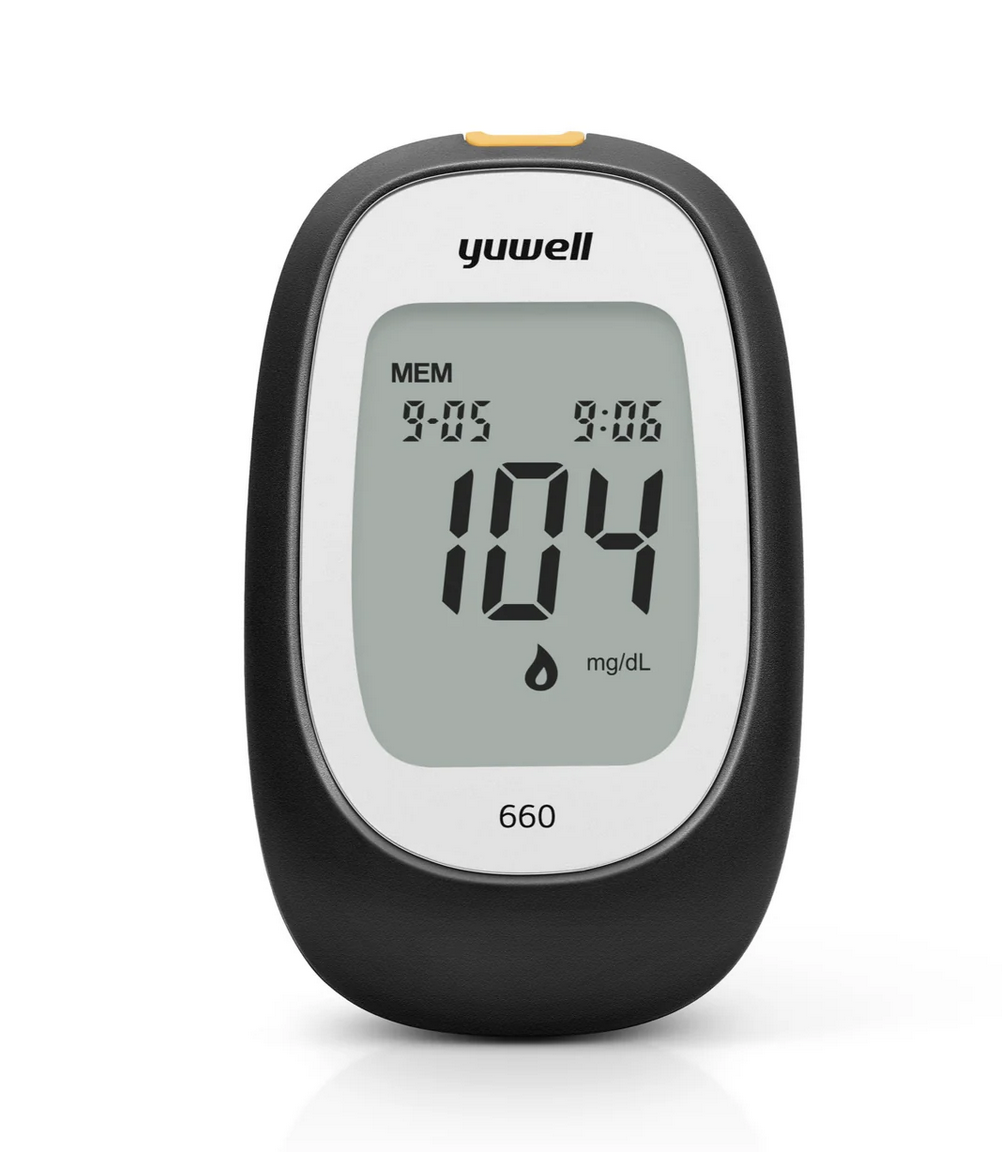
Yuwell Blood Glucose Monitor Plus 660
 Save 59%
 79 Pts
PRODUCT DESCRIPTION
The Yuwell 660 is a blood glucose meter for checking your blood sugar at home.
- Insert a strip, apply a small drop of blood from your fingertip, and the reading appears in 8 seconds. The drop it needs is very small, so the finger prick can be shallow — worth having when you test several times a day, every day.
- There is no code to enter. The meter is ready as soon as you insert a strip, which removes a step people often forget and one of the common reasons a home reading comes out wrong.
- It holds 500 readings and works out your averages over the last 7, 14, 30, 60, and 90 days. Instead of a long list of numbers, you get a view of how your control has been going — the kind of summary a doctor can actually use at a review.
- An eject button drops the used strip straight into the bin, so you never have to touch it.
- Results can be shown in mg/dL or mmol/L to match your clinic, and a Bluetooth version is available if you want readings sent to your phone.
- One set of two AAA batteries lasts for roughly 1,000 tests, and the meter is built for a five-year service life, so it is not something you expect to replace soon. At 50 grams it goes easily into a bag or a pocket for work, school, or travel.
PRODUCT DETAILS
- Model: 660
- Brand: Yuwell (Jiangsu Yuyue Medical Equipment & Supply Co., Ltd)
- Product Type: Blood Glucose Meter
MEASUREMENT
- Enzyme: FAD-GDH
- Measurement Range: 0.6–33.3 mmol/L (10–600 mg/dL)
- Unit: mg/dL or mmol/L
- Blood Volume Required: 0.8 μL
- Measuring Time: 8 seconds
- Haematocrit Range: 10%–70%
- Blood Sample: Fingertip fresh capillary whole blood or venous whole blood
FUNCTIONS
- Auto-Coding
- Strip Eject Button (listed in the comparison table; not shown on the product page)
- Memory Capacity: 500 groups
- Average Results: 7, 14, 30, 60, and 90 days
- Display Screen: LCD
- Bluetooth: Optional
OPERATING & SERVICE
- Operation Temperature: 5°C–40°C
- Equipment Operation Mode: Continuous Operation
- Service Life: 5 years
POWER
- Input Power: DC 3.0 V, 100 mA
- Battery: 2 × AAA Alkaline
- Battery Life: Approx. 1,000 measurements per set
PHYSICAL
- Weight: 50 g
- Certification: CE
PACKING SPECIFICATION
- Quantity: 20 pcs per carton
- Gross Weight / Net Weight: 5.2 / 1.0 kg
- Carton Size: 59 × 24 × 18.5 cm
CAUTION & WARNING
Before Use
- Read the user manual supplied with the meter and the insert supplied with your test strips before first use. Keep both for reference.
- Use only test strips intended for this meter. Strips made for other meters will not give a correct result.
- Check the expiry date on the strip container and do not use strips past that date.
- Once a strip container has been opened, use the strips within the period stated on the label and close the cap tightly straight after taking a strip out.
- Wash your hands with soap and warm water and dry them fully before testing. Traces of food, juice, sugar, or hand cream on the finger will change the result.
For an Accurate Reading
- Use the meter within its stated operating temperature range of 5°C to 40°C.
- Results may be unreliable outside the stated haematocrit range of 10%–70%. If you have a blood condition that affects your red cell count, ask your doctor whether this meter suits you.
- Apply the blood drop in one go and do not add more blood to a strip after the reading has started.
- Do not use a strip that is bent, damaged, or has been left out of its container.
- Check the meter with control solution if you drop it, if results do not match how you feel, or when you open a new container of strips.
- Venous whole blood must be handled and tested as your healthcare professional instructs. Test it promptly and follow the strip insert.
- Severe dehydration, very low blood pressure, shock, and some medicines can affect readings. Ask your doctor if any of these apply to you.
Who Should Take Care
- Not intended for diagnosing diabetes and not intended for use on newborns.
- Anyone who is seriously ill, dehydrated, or receiving oxygen therapy should be tested using laboratory methods, not a home meter.
- Children should test only under adult supervision.
Safe Use
- This meter measures blood glucose at a single moment. It does not diagnose or treat any condition and is not a substitute for care from a healthcare professional.
- Do not change your insulin dose, medication, diet, or exercise because of a single reading unless your doctor has told you how to.
- If a result is very high or very low, or does not match how you feel, wash your hands and test again with a new strip. If it repeats, or if you feel unwell, contact a healthcare professional.
- Treat how you feel as important information alongside the number. Symptoms of very low or very high blood sugar need attention even if the meter shows something different. In an emergency — confusion, fainting, seizure, or inability to swallow — seek urgent medical help.
- Do not disassemble, modify, or attempt to repair the meter.
Infection Control
- The meter, the lancing device, and lancets are for use by one person only. Never share them, even within a family. Blood-borne infections can pass from person to person this way.
- Use a new sterile lancet for every test. Never reuse a lancet.
- Handle used strips and lancets as contaminated waste. Put lancets in a proper sharps container and dispose of it according to your local rules.
- If a healthcare professional uses the meter on more than one patient, they must follow their facility's infection-control procedures.
Batteries
- Use two AAA alkaline batteries and insert them the correct way round.
- Do not mix old and new batteries or different battery types.
- Remove the batteries if the meter will not be used for a long time. Check the date and time setting after changing them, so stored results carry the right timestamp.
- Keep batteries, strips, and lancets away from children. If a battery or a small part is swallowed, seek medical help immediately.
Cleaning, Storage, and Disposal
- Wipe the outside of the meter with a soft cloth lightly dampened with water or a mild cleaning agent, and dry it fully. Do not let liquid enter the strip slot.
- Do not immerse the meter in water and do not use strong solvents.
- Store the meter and strips in a cool, dry place away from direct sunlight, heat, and moisture. Do not store strips in a bathroom, a car, or a refrigerator unless the strip insert says to.
- Keep the meter out of reach of children.
- Dispose of the meter, used batteries, strips, and lancets according to your local regulations. Do not put lancets in household waste.
Product Details:

Genuine brands

Temperature Controlled

Secure Payment
Genuine brands
Temperature Controlled
Secure Payment
About Product
PRODUCT DESCRIPTION
The Yuwell 660 is a blood glucose meter for checking your blood sugar at home.
- Insert a strip, apply a small drop of blood from your fingertip, and the reading appears in 8 seconds. The drop it needs is very small, so the finger prick can be shallow — worth having when you test several times a day, every day.
- There is no code to enter. The meter is ready as soon as you insert a strip, which removes a step people often forget and one of the common reasons a home reading comes out wrong.
- It holds 500 readings and works out your averages over the last 7, 14, 30, 60, and 90 days. Instead of a long list of numbers, you get a view of how your control has been going — the kind of summary a doctor can actually use at a review.
- An eject button drops the used strip straight into the bin, so you never have to touch it.
- Results can be shown in mg/dL or mmol/L to match your clinic, and a Bluetooth version is available if you want readings sent to your phone.
- One set of two AAA batteries lasts for roughly 1,000 tests, and the meter is built for a five-year service life, so it is not something you expect to replace soon. At 50 grams it goes easily into a bag or a pocket for work, school, or travel.
PRODUCT DETAILS
- Model: 660
- Brand: Yuwell (Jiangsu Yuyue Medical Equipment & Supply Co., Ltd)
- Product Type: Blood Glucose Meter
MEASUREMENT
- Enzyme: FAD-GDH
- Measurement Range: 0.6–33.3 mmol/L (10–600 mg/dL)
- Unit: mg/dL or mmol/L
- Blood Volume Required: 0.8 μL
- Measuring Time: 8 seconds
- Haematocrit Range: 10%–70%
- Blood Sample: Fingertip fresh capillary whole blood or venous whole blood
FUNCTIONS
- Auto-Coding
- Strip Eject Button (listed in the comparison table; not shown on the product page)
- Memory Capacity: 500 groups
- Average Results: 7, 14, 30, 60, and 90 days
- Display Screen: LCD
- Bluetooth: Optional
OPERATING & SERVICE
- Operation Temperature: 5°C–40°C
- Equipment Operation Mode: Continuous Operation
- Service Life: 5 years
POWER
- Input Power: DC 3.0 V, 100 mA
- Battery: 2 × AAA Alkaline
- Battery Life: Approx. 1,000 measurements per set
PHYSICAL
- Weight: 50 g
- Certification: CE
PACKING SPECIFICATION
- Quantity: 20 pcs per carton
- Gross Weight / Net Weight: 5.2 / 1.0 kg
- Carton Size: 59 × 24 × 18.5 cm
CAUTION & WARNING
Before Use
- Read the user manual supplied with the meter and the insert supplied with your test strips before first use. Keep both for reference.
- Use only test strips intended for this meter. Strips made for other meters will not give a correct result.
- Check the expiry date on the strip container and do not use strips past that date.
- Once a strip container has been opened, use the strips within the period stated on the label and close the cap tightly straight after taking a strip out.
- Wash your hands with soap and warm water and dry them fully before testing. Traces of food, juice, sugar, or hand cream on the finger will change the result.
For an Accurate Reading
- Use the meter within its stated operating temperature range of 5°C to 40°C.
- Results may be unreliable outside the stated haematocrit range of 10%–70%. If you have a blood condition that affects your red cell count, ask your doctor whether this meter suits you.
- Apply the blood drop in one go and do not add more blood to a strip after the reading has started.
- Do not use a strip that is bent, damaged, or has been left out of its container.
- Check the meter with control solution if you drop it, if results do not match how you feel, or when you open a new container of strips.
- Venous whole blood must be handled and tested as your healthcare professional instructs. Test it promptly and follow the strip insert.
- Severe dehydration, very low blood pressure, shock, and some medicines can affect readings. Ask your doctor if any of these apply to you.
Who Should Take Care
- Not intended for diagnosing diabetes and not intended for use on newborns.
- Anyone who is seriously ill, dehydrated, or receiving oxygen therapy should be tested using laboratory methods, not a home meter.
- Children should test only under adult supervision.
Safe Use
- This meter measures blood glucose at a single moment. It does not diagnose or treat any condition and is not a substitute for care from a healthcare professional.
- Do not change your insulin dose, medication, diet, or exercise because of a single reading unless your doctor has told you how to.
- If a result is very high or very low, or does not match how you feel, wash your hands and test again with a new strip. If it repeats, or if you feel unwell, contact a healthcare professional.
- Treat how you feel as important information alongside the number. Symptoms of very low or very high blood sugar need attention even if the meter shows something different. In an emergency — confusion, fainting, seizure, or inability to swallow — seek urgent medical help.
- Do not disassemble, modify, or attempt to repair the meter.
Infection Control
- The meter, the lancing device, and lancets are for use by one person only. Never share them, even within a family. Blood-borne infections can pass from person to person this way.
- Use a new sterile lancet for every test. Never reuse a lancet.
- Handle used strips and lancets as contaminated waste. Put lancets in a proper sharps container and dispose of it according to your local rules.
- If a healthcare professional uses the meter on more than one patient, they must follow their facility's infection-control procedures.
Batteries
- Use two AAA alkaline batteries and insert them the correct way round.
- Do not mix old and new batteries or different battery types.
- Remove the batteries if the meter will not be used for a long time. Check the date and time setting after changing them, so stored results carry the right timestamp.
- Keep batteries, strips, and lancets away from children. If a battery or a small part is swallowed, seek medical help immediately.
Cleaning, Storage, and Disposal
- Wipe the outside of the meter with a soft cloth lightly dampened with water or a mild cleaning agent, and dry it fully. Do not let liquid enter the strip slot.
- Do not immerse the meter in water and do not use strong solvents.
- Store the meter and strips in a cool, dry place away from direct sunlight, heat, and moisture. Do not store strips in a bathroom, a car, or a refrigerator unless the strip insert says to.
- Keep the meter out of reach of children.
- Dispose of the meter, used batteries, strips, and lancets according to your local regulations. Do not put lancets in household waste.
Product Details: