



Dalacin Clindamycin 2% - 40 gm Vaginal Cream
35.80
- Product Form: Vaginal Cream
- Ingredient: Clindamycin Phosphate
- Concentration: 2%
- Quantity: 1 Pc
- Brand: Dalacin
Home delivery within 2 hours
Home delivery within 2 hours
Product Overview:
- Dalacin (Clindamycin) is an antibiotic that fights bacteria in the body.
- Clindamycin is used to treat serious infections caused by bacteria.
- Clindamycin is usually available as one of three salts: clindamycin phosphate, clindamycin hydrochloride, or clindamycin nicotinamide. These salt forms are all prodrugs of clindamycin but once inside the body or applied to the skin, they are rapidly converted to active clindamycin by hydrolysis. All three salt forms of clindamycin: clindamycin phosphate, clindamycin hydrochloride, and clindamycin nicotinamide have the same antimicrobial spectrum and effectiveness.This product contains 40 gm of cream.

Key Features:
- Contains Clindamycin Phosphate for targeted treatment.
- Effective against symptomatic bacterial vaginosis.
- Nourishing formula to enhance comfort.
How it Works:
- Topical clindamycin is thought to work by stopping the growth of bacteria (germs) that cause acne.
Benefits:
- Clindamycin may be used to treat a wide range of infections, although it should be used only to treat or prevent infections that are proven or strongly suspected to be caused by susceptible bacteria to reduce the development of drug-resistant bacteria and to maintain its effectiveness.
Infections clindamycin treats in adults and children include serious:
- Infections caused by susceptible anaerobic bacteria
- Infections due to susceptible isolates of streptococci, pneumococci, and staphylococci, if a less toxic alternative (such as erythromycin) is not suitable
- Lower respiratory tract infections including pneumonia, empyema, and lung abscess caused by susceptible isolates of anaerobes, Streptococcus pneumoniae, other streptococci (except Enterococcus faecalis), and Staphylococcus aureus in adults and children
- Skin and skin structure infections caused by susceptible isolates of Streptococcus pyogenes, Staphylococcus aureus, and anaerobes in adults and children
- Topical clindamycin 1% may be used to help treat and control severe acne.
- Gynecological infections including endometritis, nongonococcal tubo-ovarian abscess, pelvic cellulitis, and postsurgical vaginal cuff infection caused by susceptible anaerobes in adults and children
- Intra-abdominal infections including peritonitis and intra-abdominal abscesses caused by susceptible anaerobic organisms in adults and children
- Septicemia caused by susceptible isolates of Staphylococcus aureus, streptococci (except E. faecalis), and susceptible anaerobes in adults and children
- Bone and joint infections including acute hematogenous osteomyelitis caused by susceptible isolates of S. aureus and as adjunctive therapy in the surgical treatment of chronic bone and joint infections due to susceptible organisms in adults and children.
Directions for Use:
- This medication is only for use in the vagina. Do not take by mouth. Wash your hands before and after use. Do not get it in your eyes. If you do, rinse your eyes with plenty of cool tap water. Use it as directed on the prescription label. Do not use it more often than directed. Use the medication for the full course as directed by your care team, even if you think you are better. Do not stop using it unless your care team tells you to stop it early.
- Place the medication in the vagina using the special applicator supplied with the cream. Fill the applicator with cream. Lie on your back, part and bend your knees. Gently insert the applicator into the vagina and push the plunger to place the cream into the vagina.
- This medication comes with INSTRUCTIONS FOR USE. Ask your pharmacist for directions on how to use this medication. Read the information carefully. Talk to your pharmacist or care team if you have questions.
Active Ingredients:
- Clindamycin Phosphate 2%

Side Effects:
The most common clindamycin side effects include:
- nausea or vomiting
- stomach (abdominal) pain
- mild skin rash
- vaginal itching or discharge.
- Clindamycin may also cause a metallic taste in your mouth. Talk to your healthcare provider about ways you can manage this.
- Serious side effects and warnings
- Clindamycin carries a Boxed Warning for Clostridium difficile-associated diarrhea (CDAD).
- Clindamycin can cause diarrhea, which may range in severity from mild to fatal colitis. Diarrhea associated with clindamycin use is sometimes caused by an overgrowth of dangerous Clostridium difficile bacteria in the large intestine. Seniors especially should be monitored for diarrhea. If you have diarrhea that is watery or bloody, stop using clindamycin and call your doctor. Do not use anti-diarrhea medicine unless your doctor tells you to. Seek urgent medical attention.
- Get emergency medical help if you have any signs of an allergic reaction to clindamycin (hives, difficulty breathing, swelling in your face or throat), symptoms of a heart problem (chest pain, shortness of breath), or a severe skin reaction (fever, sore throat, burning in your eyes, skin pain, red or purple skin rash that spreads and causes blistering and peeling).
- Serious skin and other reactions can occur with clindamycin. Seek medical treatment if you have symptoms of a drug reaction such as skin rash, fever, swollen glands, flu-like symptoms, muscle aches, severe weakness, unusual bruising, or yellowing of your skin or eyes. This reaction may occur several weeks after starting clindamycin.
Call your healthcare provider at once if you have:
- any change in bowel habits (for example, you start going to the toilet very frequently or don't go at all)
- severe stomach pain
- diarrhea that is watery or bloody
- little or no urination.
Cautions & Warnings:
- Other drugs may interact with clindamycin, including prescription and over-the-counter medicines, vitamins, and herbal products. Tell each of your health care providers about all medicines you use now and any medicines you start or stop using.
- Clindamycin has been shown to have neuromuscular blocking properties that may enhance the action of other neuromuscular blocking agents, such as succinylcholine, rocuronium, or vecuronium. Use with caution.
- Do not use topical clindamycin unless it has been prescribed to you by a health care provider. Use it as prescribed.
- Do not share topical clindamycin with other people, even if they have the same condition as you. It may harm them.
- Pregnancy. It is not known if or how topical clindamycin could affect pregnancy or harm an unborn baby. Tell your health care provider if you are pregnant or plan to become pregnant.
- Breastfeeding. It is not known if topical clindamycin passes into breast milk. Tell your health care provider if you are breastfeeding or plan to breastfeed. Your health care provider will let you know if you should use topical clindamycin while breastfeeding. If you use topical clindamycin while breastfeeding, and you apply it to your chest area, do not apply it to areas where it could get it into your baby’s mouth.
Storage:
- Stored at room temperature, between 68 F and 77 F (20 C and 25 C). It can be exposed to temperatures between 59 F and 86 F (15 C and 30 C) for shorter periods of time, such as when you’re transporting it. Store it in a cool, dry place, and do not freeze it.
FAQ:
- Q: What if I miss a dose?
- A: If you miss a dose, use it as soon as you can. If it is almost time for your next dose, use only that dose. Do not use double or extra doses.
- Q: What may interact with this medication?
- A: Interactions are not expected. Do not use any other vaginal products without telling your care team.
- Q: What should I avoid while using clindamycin?
- A: Do not use clindamycin at the same time as erythromycin, another antibiotic.
- Q: How long does clindamycin take to start working?
- A: When taken by mouth, clindamycin starts working within 45 minutes. However, it can take a few days to weeks before you notice an improvement in your symptoms. The exact timing depends on the infection type, severity, and whether it is taken by mouth, injected, applied on the skin, or used vaginally.
- Q: Is clindamycin a strong antibiotic?
- A: Clindamycin is a strong broad-spectrum antibiotic, typically prescribed for serious infections, such as life-threatening methicillin-resistant Staphylococcus aureus (MRSA) skin infections.
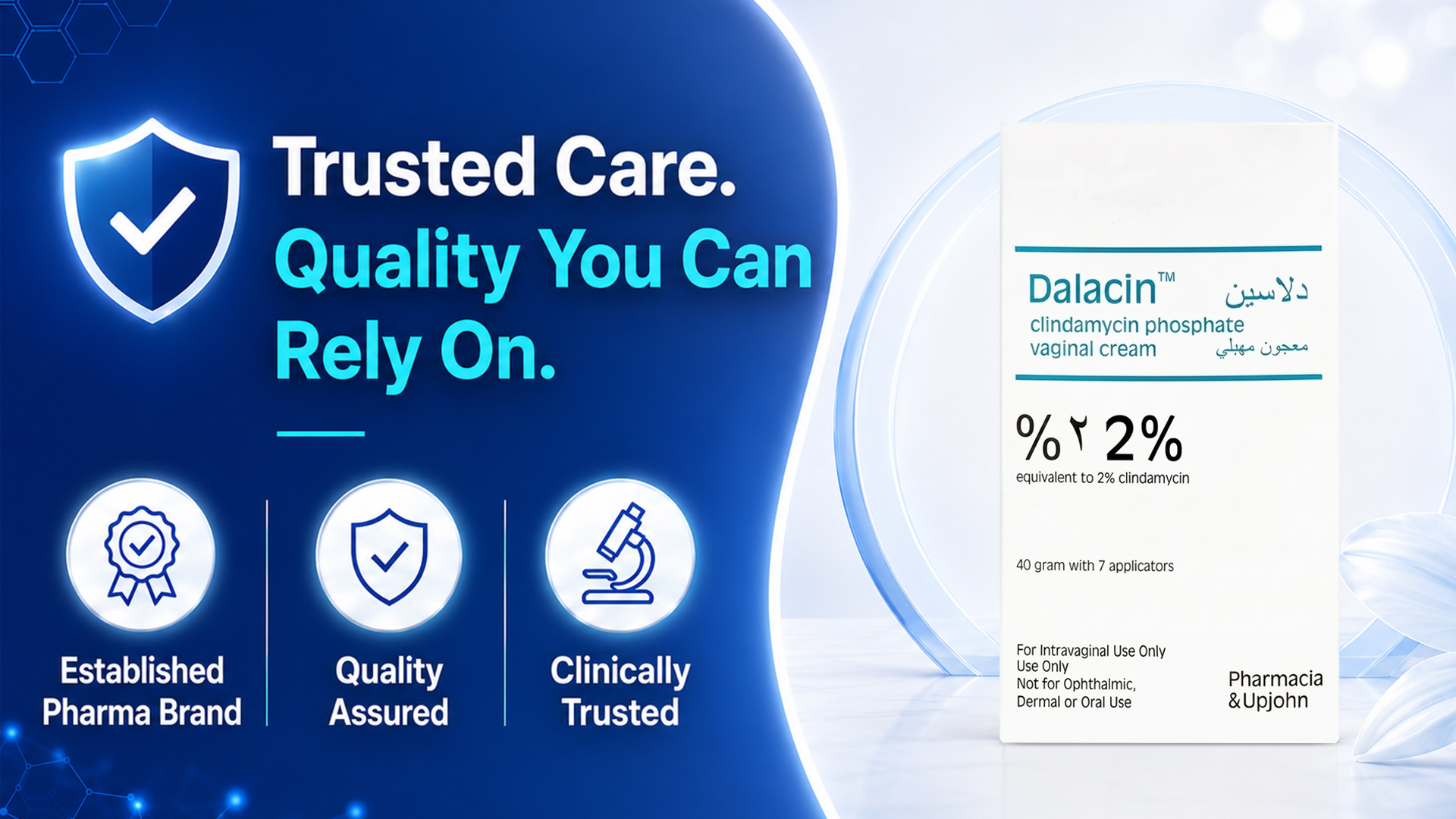
Product Details:
- Concentration: 2%
- Ingredient: Clindamycin Phosphate
- Product Form: Vaginal Cream
- Quantity: 1 Pc
- Brand: Dalacin

Genuine brands

Temperature Controlled

Secure Payment
- Product Form: Vaginal Cream
- Ingredient: Clindamycin Phosphate
- Concentration: 2%
- Quantity: 1 Pc
- Brand: Dalacin
Genuine brands
Temperature Controlled
Secure Payment
About Product
Product Overview:
- Dalacin (Clindamycin) is an antibiotic that fights bacteria in the body.
- Clindamycin is used to treat serious infections caused by bacteria.
- Clindamycin is usually available as one of three salts: clindamycin phosphate, clindamycin hydrochloride, or clindamycin nicotinamide. These salt forms are all prodrugs of clindamycin but once inside the body or applied to the skin, they are rapidly converted to active clindamycin by hydrolysis. All three salt forms of clindamycin: clindamycin phosphate, clindamycin hydrochloride, and clindamycin nicotinamide have the same antimicrobial spectrum and effectiveness.This product contains 40 gm of cream.
Key Features:
- Contains Clindamycin Phosphate for targeted treatment.
- Effective against symptomatic bacterial vaginosis.
- Nourishing formula to enhance comfort.
How it Works:
- Topical clindamycin is thought to work by stopping the growth of bacteria (germs) that cause acne.
Benefits:
- Clindamycin may be used to treat a wide range of infections, although it should be used only to treat or prevent infections that are proven or strongly suspected to be caused by susceptible bacteria to reduce the development of drug-resistant bacteria and to maintain its effectiveness.
Infections clindamycin treats in adults and children include serious:
- Infections caused by susceptible anaerobic bacteria
- Infections due to susceptible isolates of streptococci, pneumococci, and staphylococci, if a less toxic alternative (such as erythromycin) is not suitable
- Lower respiratory tract infections including pneumonia, empyema, and lung abscess caused by susceptible isolates of anaerobes, Streptococcus pneumoniae, other streptococci (except Enterococcus faecalis), and Staphylococcus aureus in adults and children
- Skin and skin structure infections caused by susceptible isolates of Streptococcus pyogenes, Staphylococcus aureus, and anaerobes in adults and children
- Topical clindamycin 1% may be used to help treat and control severe acne.
- Gynecological infections including endometritis, nongonococcal tubo-ovarian abscess, pelvic cellulitis, and postsurgical vaginal cuff infection caused by susceptible anaerobes in adults and children
- Intra-abdominal infections including peritonitis and intra-abdominal abscesses caused by susceptible anaerobic organisms in adults and children
- Septicemia caused by susceptible isolates of Staphylococcus aureus, streptococci (except E. faecalis), and susceptible anaerobes in adults and children
- Bone and joint infections including acute hematogenous osteomyelitis caused by susceptible isolates of S. aureus and as adjunctive therapy in the surgical treatment of chronic bone and joint infections due to susceptible organisms in adults and children.
Directions for Use:
- This medication is only for use in the vagina. Do not take by mouth. Wash your hands before and after use. Do not get it in your eyes. If you do, rinse your eyes with plenty of cool tap water. Use it as directed on the prescription label. Do not use it more often than directed. Use the medication for the full course as directed by your care team, even if you think you are better. Do not stop using it unless your care team tells you to stop it early.
- Place the medication in the vagina using the special applicator supplied with the cream. Fill the applicator with cream. Lie on your back, part and bend your knees. Gently insert the applicator into the vagina and push the plunger to place the cream into the vagina.
- This medication comes with INSTRUCTIONS FOR USE. Ask your pharmacist for directions on how to use this medication. Read the information carefully. Talk to your pharmacist or care team if you have questions.
Active Ingredients:
- Clindamycin Phosphate 2%
Side Effects:
The most common clindamycin side effects include:
- nausea or vomiting
- stomach (abdominal) pain
- mild skin rash
- vaginal itching or discharge.
- Clindamycin may also cause a metallic taste in your mouth. Talk to your healthcare provider about ways you can manage this.
- Serious side effects and warnings
- Clindamycin carries a Boxed Warning for Clostridium difficile-associated diarrhea (CDAD).
- Clindamycin can cause diarrhea, which may range in severity from mild to fatal colitis. Diarrhea associated with clindamycin use is sometimes caused by an overgrowth of dangerous Clostridium difficile bacteria in the large intestine. Seniors especially should be monitored for diarrhea. If you have diarrhea that is watery or bloody, stop using clindamycin and call your doctor. Do not use anti-diarrhea medicine unless your doctor tells you to. Seek urgent medical attention.
- Get emergency medical help if you have any signs of an allergic reaction to clindamycin (hives, difficulty breathing, swelling in your face or throat), symptoms of a heart problem (chest pain, shortness of breath), or a severe skin reaction (fever, sore throat, burning in your eyes, skin pain, red or purple skin rash that spreads and causes blistering and peeling).
- Serious skin and other reactions can occur with clindamycin. Seek medical treatment if you have symptoms of a drug reaction such as skin rash, fever, swollen glands, flu-like symptoms, muscle aches, severe weakness, unusual bruising, or yellowing of your skin or eyes. This reaction may occur several weeks after starting clindamycin.
Call your healthcare provider at once if you have:
- any change in bowel habits (for example, you start going to the toilet very frequently or don't go at all)
- severe stomach pain
- diarrhea that is watery or bloody
- little or no urination.
Cautions & Warnings:
- Other drugs may interact with clindamycin, including prescription and over-the-counter medicines, vitamins, and herbal products. Tell each of your health care providers about all medicines you use now and any medicines you start or stop using.
- Clindamycin has been shown to have neuromuscular blocking properties that may enhance the action of other neuromuscular blocking agents, such as succinylcholine, rocuronium, or vecuronium. Use with caution.
- Do not use topical clindamycin unless it has been prescribed to you by a health care provider. Use it as prescribed.
- Do not share topical clindamycin with other people, even if they have the same condition as you. It may harm them.
- Pregnancy. It is not known if or how topical clindamycin could affect pregnancy or harm an unborn baby. Tell your health care provider if you are pregnant or plan to become pregnant.
- Breastfeeding. It is not known if topical clindamycin passes into breast milk. Tell your health care provider if you are breastfeeding or plan to breastfeed. Your health care provider will let you know if you should use topical clindamycin while breastfeeding. If you use topical clindamycin while breastfeeding, and you apply it to your chest area, do not apply it to areas where it could get it into your baby’s mouth.
Storage:
- Stored at room temperature, between 68 F and 77 F (20 C and 25 C). It can be exposed to temperatures between 59 F and 86 F (15 C and 30 C) for shorter periods of time, such as when you’re transporting it. Store it in a cool, dry place, and do not freeze it.
FAQ:
- Q: What if I miss a dose?
- A: If you miss a dose, use it as soon as you can. If it is almost time for your next dose, use only that dose. Do not use double or extra doses.
- Q: What may interact with this medication?
- A: Interactions are not expected. Do not use any other vaginal products without telling your care team.
- Q: What should I avoid while using clindamycin?
- A: Do not use clindamycin at the same time as erythromycin, another antibiotic.
- Q: How long does clindamycin take to start working?
- A: When taken by mouth, clindamycin starts working within 45 minutes. However, it can take a few days to weeks before you notice an improvement in your symptoms. The exact timing depends on the infection type, severity, and whether it is taken by mouth, injected, applied on the skin, or used vaginally.
- Q: Is clindamycin a strong antibiotic?
- A: Clindamycin is a strong broad-spectrum antibiotic, typically prescribed for serious infections, such as life-threatening methicillin-resistant Staphylococcus aureus (MRSA) skin infections.
Product Details:
- Concentration: 2%
- Ingredient: Clindamycin Phosphate
- Product Form: Vaginal Cream
- Quantity: 1 Pc
- Brand: Dalacin